quinta-feira, 9 de julho de 2020

RELATIVE PRONOUN

 RELATIVE PRONOUNS
8º ANO
CLASS 09/07/2020


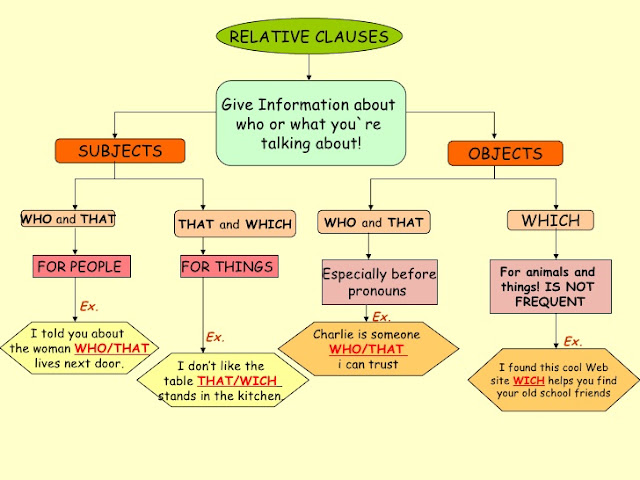
Para entendermos o que são os Relative Pronouns (Pronomes Relativos), temos que entender seu nome. Primeiro, vemos que estamos falando de Pronomes, e a função de um Pronome é substituir um nome. Mas não é um pronome qualquer, é um Pronome Relativo, pois cria uma relação entre duas frases distintas, quando estas possuem um elemento em comum. Vamos ver no português como eles funcionam com as seguintes frases:
Eu gosto da minha vizinha. A minha vizinha é Australiana.
Nas duas frases acima, temos um elemento que se repete, que é “minha vizinha”. Logo, podemos substituir este nome por um Pronome Relativo, relacionando as duas frases. Assim temos:
Eu gosto da minha vizinha que (ou a qual) é Australiana.
O uso dos Pronomes Relativos no Inglês é muito semelhante! Vamos ver o exemplo acima em Inglês.
I like my neighbor. My neighbor is Australian.
Nas frases acima o elemento em comum é “my neighbor” (minha vizinha). Como ela é uma pessoa, substituímos estas palavras pelo pronome relativo adequado, que é who.
I like my neighbor who is Australian.
Note que dependendo do elemento repetido, temos que usar um pronome específico. Observe o caso a seguir:

I drive this car. This car is black.
(Eu dirijo este carro. Este carro é preto)

Nas frases acima, “this car” se repete. Como estamos falando de uma coisa, substituímos então pelo pronome adequado which.
I drive this car, which is black.

Também podemos usar o pronome that quando estamos falando de coisas ou também de pessoas. Ou seja, se o elemento em comum (o que queremos substituir por um pronome) for uma pessoa podemos usar tanto o pronome who quanto that. Se for uma coisa, podemos usar tanto which quanto that. No entanto, tome muito cuidado, pois existe uma situação em que não podemos usar o that, que é quando estamos usando um aposto explicativo. Veja o próximo exemplo:
Meu filho que é famoso comprou uma casa nova.

As duas frases são muito parecidas, mas na primeira temos um aposto explicativo. Ali estamos explicando algo sobre o “meu filho”. Logo, a pessoa que disse isso possui apenas um filho. Já na segunda frase, temos um aposto restritivo, já que estamos falando de um filho específico, aquele que é famoso. Logo, a pessoa que disse isso possui mais de um filho, mas estamos falando sobre apenas um deles.
O Inglês funciona da mesma maneira, e seguindo a regra de que não podemos usar o “that” em apostos explicativos, na primeira frase seu uso é proibido. Já na segunda, poderíamos utilizá-lo:

My son, who is famous, bought a new house.
My son 
who (ou that) is famous bought a new house.
The teacher whom I called yesterday is blonde.
O professor para quem eu liguei ontem é loiro.
Estes são os principais pronomes relativos! Para resumir, temos a seguinte tabela, com o uso de cada pronome, e alguns exemplos, para que você salve e guarde para sempre um ótimo resuminho de pronomes relativos!


RESUMO

BLOG "INGLÊS dos Vestibulares & Concursos Públicos" com + 9000 ...


ATIVIDADE ESCRITA 


1 – (Eear 2019)
The film, __________ is directed by J. J. Abrams and continues the interstellar saga of Luke Skywalker, Princess Leia and Han Solo some 30 years after the events of “Return of the Jedi” (1983), is also a launching pad for two young actors who are barely half as old as the “Star Wars” franchise itself.

Choose the best alternative to complete the text.
a) whose
b) which
c) where
d) who

2 – (Adaptado de Unesp 2017)
“A study from Brigham Young University reported that teenagers _______ sleep seven hours, compared to nine hours of sleep, perform better academically.”
Assinale a alternativa que completa corretamente a lacuna numerada no texto

a) which.
b) when.
c) while.
d) whoever.
e) who.

3 – (Uema 2015)

In 1985, Frejat, then guitarist for Barão Vermelho, hit the stage wearing green and yellow clothes. It was January 15th, the day in which Tancredo Neves was named president of Brazil. Cazuza sang “Pro Dia Nascer Feliz” with lots of enthusiasm.
Frejat returns to the festival this year for a solo performance on October 1st.

Fonte: Disponível em: TAM. TAM nas nuvens. São Paulo: New Content Editora, set/2011.

O fragmento que apresenta um pronome relativo é
a) “In 1985”
b) “president of Brazil”
c) “with lots of enthusiasm”
d) “this year for a solo performance”
e) “the day in which Tancredo Neves”

4 – (Imed 2015)
Mark Twain (1835-1910), ______ real name was Samuel Langhorne Clemens, was the first writer of importance born west of the Mississipi River.

O pronome relativo que preenche corretamente a lacuna na referência 1 é:
a) that
b) which
c) whose
d) what
e) whom

5 – (Uemg 2015)
Complete with relative pronouns

Read the passage below to complete the gaps with the relative pronouns:

Online friends are people _______ always post messages and pictures of the places _______ they are, _______ they are with and ______ they are doing.

Atividade oral

* Phycal appearance 
Atenção a pagina 83 do seu livro. Realizar tendo como fonte cidade Paulo Afonso.
Sugestões:


Going to

FUTURE GOINGO TO
CLASS 09.07.2020


O going to é uma expressão utilizada no inglês para falar de planos e intenções futuras.
Ele é usado quando a pessoa já decidiu o que vai fazer. Ou seja, quando uma ação já está planejada e irá acontecer num futuro próximo.
Regras
Confira abaixo as regras de formação do going to:
Afirmativa (Affirmative Form): sujeito + verbo to be + going to + infinitivo do verbo principal sem “to”.
Exemplo: I am going to work. (Eu irei trabalhar)
Negativa (Negative Form): sujeito + verbo to be + not + going to + infinitivo do verbo principal sem “to”.
Exemplo: I am not going to work. (Eu não irei trabalhar)
Interrogativa (Interrrogative Form): verbo to be + sujeito + going to + infinitivo do verbo principal sem “to”
Exemplo: Am I going to work? (Eu irei trabalhar?)
Affirmative
Negative
Interrogative
I am going to
I am not going to
Am I going to?
You are going to
You are not going to
Are you going to?
He is going to
He is not going to
Is he going to?
She is going to
She is not going to
Is she going to?
It is going to
It is not going to
Is it going to?
We are going to
We are not going to
Are we going to?
You are going to
You are not going to
Are you going to?
They are going to
They are not going to
Are they going to?
Obs: é comum os usos das contrações nas frases afirmativas e negativas:
Affirmative Form
Negative Form
I am – I’m
I’m not
You are – You’re
You aren’t
He is – He’s
He isn’t
She is – She’s
She isn’t
It is – It’s
It isn’t
We are – We’re
You aren’t
You are – You’re
We aren’t
They are – They’re
They aren’t

Curiosidade sobre o uso de going to

Apesar de a gramática normativa da língua inglesa não recomendar esta grafia, no inglês falado o going to é frequentemente substituído pela forma gonna, que acaba por reproduzir o som de going to quando dito rapidamente em uma frase.
A frase I am going to work out (Vou me exercitar) 
Poderia ser substituída por I'm gonna work out no inglês falado.
Quando substituído, perceba que não usaremos to. 
Gonna também é uma palavra muito utilizada em músicas.


Vamos relembrar:

Will e Going To
Tanto o will como o going to são usados no tempo futuro. No entanto, o will é utilizado para fazer previsões no futuro, ou seja, trata-se de um futuro incerto.
Com ele, é muito comum o uso dos verbos: think (achar), hope (esperar), guess (achar) e to be sure (ter certeza).
Além disso, expressões que geram incerteza também são comuns: probably (provavelmente), possibly (possivelmente), maybe (talvez), perhaps (talvez), etc.

Exemplos:
I think there will be a nuclear accident. (Eu acho que vai haver um acidente nuclear)
I’m sure there will be more homeless people in the future. (Tenho certeza que no futuro haverá mais pessoas desabrigadas)

Regras
Confira abaixo as regras de formação do will:
Afirmativa (Affirmative Form): sujeito + will + verbo principal + complemento
Exemplo: Probably I will work tomorrow. (Provavelmente eu vou trabalhar amanhã)
Obs: é comum o verbo will aparecer com a contração: will (‘ll): I’ll work.
Negativa (Negative Form): sujeito + will + not + verbo principal + complemento
Exemplo: Possibly I will not work tomorrow. (Possivelmente eu não vou trabalhar amanhã)
Obs: a forma negativa pode vir escrita com a contração: will + not: won’t
Interrogativa (Interrogative Form): will + sujeito + verbo principal + complemento
Exemplo: Will I work tomorrow? (Vou trabalhar amanhã?)

ATIVIDADE ESCRITA

Exercises

1.Chose the best alternative that has the same meaning as the sentence bellow:


 (Furb-SC) What are you going to do?
a) I travel to Los Angeles.
b) I do my homework.
c) I'm going to call to the police.
d) We're going not to do that.
e) We'll think about it last week.


2.Chose the best alternative that has the same meaning as the sentence bellow:


 (UFRR-2010)
Mary: "I am about to fall asleep. I need to wake up!"
Clare: "I______you some coffee."
a) 'll go
b) am going to get
c) will get
d) am going to get to
e) will go to get


3. Fill in the blanks using going to.

a) My father ________________________ (buy) a car.
b) Our classmates _____________________(enjoy) their afternoon watching movies.
c) I'm so sad! My best friend May___________________ (move) to another city.
d) My neighbours_____________________ (build) a new garage.
e) My friends and I _____________________(learn) Italian.

4. Underline the correct alternative:


a) There is no rice! I (will / am going to) get some.
b) Cayo's presentation ( will be / is going) next week.
c) I ( will / am going to) design a new jacket for her party.
d) She told she ( will to / is going to) show everything for her friend.
e) They said their parents (will / are going) come to party


5. Chose the best alternative that has the same meaning as the sentence bellow:

He will talk to his brother after school.

a) He going to talk to his brother after school.
b) He's going talk to his brother after school.
c) He's going to talk to his brother after school.
d) He is going talk to his brother after school.
e) He going to talk his brother after school.


CONFIRA SEUS ACERTOS.


ATIVIDADE ORAL

Propaganda de turismo : abordar os pontos turísticos de Paulo Afonso

* Video

Sugestões musicais